Continued from part 3.
What is the purpose of the Book of Mormon?
Sometimes we say the Book of Mormon has one purpose, but the way in which it gets used by the Church suggests they have a different purpose.
For example, the Introduction to the Book of Mormon. The way we see it today on the first pages of the book was not part of the gold plates. It was first published in 1981 and credited to Bruce R. McConkie. In it we find some basic descriptions of the book, and towards the end we get an interesting line of reasoning. Goes like this: If the Book of Mormon is true, then Joseph was a prophet, and if a prophet, then the Church of Jesus Christ of Latter-day Saints is the only true church, and we have a living prophet, and so you need come aboard.
Tad Callister, Sunday School General President November 1, 2016 says it this way:
Because the Book of Mormon is “the keystone of our religion,” as described by Joseph Smith, the Church rises or falls on the truth of it.
As a result, if the Book of Mormon can be proved to be man-made, then the Church is man-made. On the other hand, if its origin is God-given, then Joseph Smith was a prophet, and if he was a prophet, then The Church of Jesus Christ of Latter-day Saints is true. It is that simple.
Ensign Articles often put it this way: (Dec 2015)
Think about it. Everything you know in the Church, everything you believe, everything you do, really hinges on this question: Was Joseph Smith really called as a prophet? If the answer is yes, then the Church really is true, the Book of Mormon really is a book of holy scripture, the doctrines of the Church are true, and the Church really is led by prophets today. That pretty much affects every aspect of your life.
Similar reasoning is also found at the end of the Introduction to the Book of Mormon, last paragraph.
Those who gain this divine witness from the Holy Spirit will also come to know by the same power that Jesus Christ is the Savior of the world, that Joseph Smith is His revelator and prophet in these last days, and that The Church of Jesus Christ of Latter-day Saints is the Lord’s kingdom once again established on the earth, preparatory to the Second Coming of the Messiah.
This reasoning begins with the Book of Mormon and Joseph Smith, then uses those to lead us to a conclusion regarding the truth claims of The Church of Jesus Christ of Latter-day Saints and its current leaders. This is problematic for various reasons, one of which is the fact that there are various other Churches who believe in the Book of Mormon as well as Joseph Smith. Dozens and dozens in fact. Dozens of breakoff churches claim Joseph as their founder. Does the truthfulness of the Book of Mormon also prove those churches are all true? And prove that they too hold true priesthood?
Clearly these lines of reasoning do not teach us the book's intended purpose. It's a detour.
Prior to that paragraph above from the official introduction, we get this quote from Joseph Smith
“I told the brethren that the Book of Mormon was the most correct of any book on earth, and the keystone of our religion, and a man would get nearer to God by abiding by its precepts, than by any other book”
Joseph's statement refers to the book itself, that it could bring someone closer to God more so than any other book. Closeness to God was the outcome Joseph spoke of. The book's true purpose clearly wasn't a marketing tool to bolster one of many break-off Church's claims in order to grow the membership base. When the BofM is used like that can it bring us the results Joseph had in mind? It suggests once you are a member, the book can be put on a shelf, and given equal or lesser importance as manuals, handbooks, and Church leaders since current Church leaders are taught to be more vital than the Book of Mormon (14 fundamentals of following the prophet). If we want the results Joseph spoke of, we will need to use it in the way he said to.
Keystone of our Religion
Joseph said the book is the keystone of our religion. We tend to define "religion" as a formal corporate organization with logos, PR departments, legal departments, and an entity with a Tax ID number. But the scriptures do not define religion (or church) that way. So perhaps we need to listen more to the scriptures if we want to catch Joseph's vision of religion, and thus how this book can be the "keystone of our religion".
James 1:27: Pure and undefiled religion before God and the Father is this: to visit orphans and widows in their trouble, and to keep oneself unspotted from the world.
Is there anything corporate in that definition of pure and undefiled religion from James 1:27? Could that "religion" be practiced without a formal organization? Of course.
Keystone: In figurative contexts: a person or thing occupying a high, central, principle or vital position in a system or ideology etc..
The Keystone of our religion (not corporation) is the Book of Mormon. What if we actually did that, and started with the Book of Mormon first, as the central, vital, and principle element of our beliefs? As mentioned last post, the Book of Mormon was first published before the Church of Jesus Christ of Latter-day Saints was even organized. It was published March of 1830. The Church was organized April of 1830. What would you say could be the message from God in that sequence of events? God, who oversees his work, history, time, space, and mankind, lined up a sequence of events where the Book of Mormon came first, and independent. Wonder why?
So, what is the Book of Mormon for if it’s not a domino in a chain to prove which church is true and therefore which leaders to follow?
What if we bypass all these distracting detours about the book's purpose and go back to what Joseph said. Let's see how to use it to get closer to God. Because that's the goal. Not to build a religious empire, but to find harmony with God.
The unique nature of the Book of Mormon:
The Book of Mormon is unique for a variety of reasons. Lehi’s family left approximately four years before Jerusalem’s fall to Babylon. They took with them records and a tradition of faith which they then continued to preserve in a new land. That record and practice of faith were not influenced by the subsequent Babylonian captivity of the Jews. From the time they left, through the end of the Nephite record, the Book of Mormon escaped Babylonian culture, thought, customs and language. What other book can make a claim to have avoided all those influences the scriptures warn us about?
The Book of Mormon is the only pre-exilic document in existence today, that was transmitted by a prophet to a prophet, to publication and then to us. All other records have passed through hands (and minds) influenced to one degree or another by the Babylonians, Medes and Persians, Romans, and modern corruptions. These are referenced in Daniels interpretation of Nebuchadnezzar's dream with the statue in the second book of Daniel.
The Book of Mormon is the only text we have that survives without corruption of false religious ideas from history. So, if we want to come to Christ, we should use as our source something not inflected by Babylonian influences which, according to Daniel's dream, are all slated to be ground to dust. The Lord gave us a key.
As C. S. Lewis explained:
Every age has its own outlook. It is specially good at seeing certain truths and specially liable to make certain mistakes. We all, therefore, need the books that will correct the characteristic mistakes of our own period.…
We need intimate knowledge of the past. Not that the past has any magic about it, but because we cannot study the future, and yet need something to set against the present, to remind us that periods and that much which seems certain to the uneducated is merely temporary fashion.
A man who has lived in many places is not likely to be deceived by the local errors of his native village: the scholar has lived in many times and is therefore in some degree immune from the great cataract of nonsense that pours from the press and the microphone of his own age.
So imagine what Nephi and Moroni have to teach us?
Oh, you want Religion?
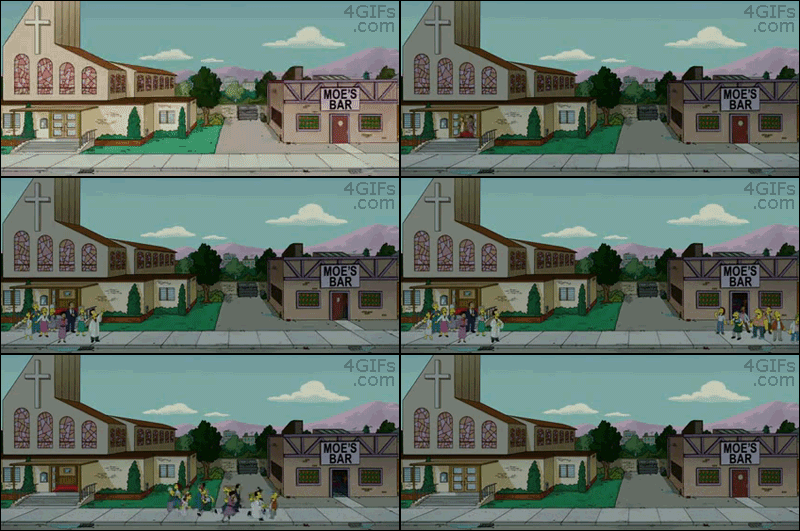
I sometimes can't help but think about the Simpsons when the topic of religion comes up. It was always a favorite show of mine growing up despite my parent's protests. This clip below is just too funny not to share. Springfield had become so environmentally polluted that the government was bringing in a giant glass dome to quarantine off the city. As this dome is being delivered from above by a fleet of helicopters, the worshippers in the church and the alcoholic bar patrons both run outside to see what's going on. After seeing the apocalyptic visual, the two groups hilariously swap places! The bar patrons suddenly run to religion and the religionists suddenly run to the alcohol.
Video in case the gif doesn't work.
Anyway, it's been said that there is an ongoing competition, one that seeks to turning the gospel of Christ into religion. And then to turn the religion away from its founding. We need to be on guard. This has happened before and is happening again.
The religion and faith in the Book of Mormon brought its authors into direct contact with Christ. Now what Joseph Smith said about the book starts to form an interesting and intriguing picture. What if we consider the book as a manual. An ascension text that will convince people of Christ by bringing them literally to Him. Not just bring them aboard a Church institution. The book has examples, doctrine, prophecies and teachings that have escaped Babylonian influence. The first page has Lehi in direct contact with God. These are not emotional and whimsical events, but literal, tangible experiences with God and angels right from page number 1.
The wrong way to use a key is to use it to be prideful. God doesn't give us things to prop up our pride. Suppose the fullness of the Gospel is in the Book of Mormon (I believe it is), and people therefore feel great pride and superiority as a result of their religion's acceptance of the book? Does that help them use the key? Will using a key in that way ever open anything? The Book of Mormon’s purpose can't be to solidify that ours is the only true Church and that as members our understanding is therefore superior to everyone else. That key opens nothing.
Have we been using the book incorrectly?
Suppose for a minute we take our modern day Church and Gospel vocabulary, and all the ideas, definitions, Sunday school conversations and then overlay all of that on top of the Book of Mormon text. This happens all the time. It leads us to assume “this” thing that we do s part of our religious culture is the exact same as “that” thing you read about in the Book of Mormon. They use the same terms so they must be equal, right? The Church leaders and manuals teach and encourage us to make these equivalencies. One example: Book of Mormon Student Manual talking about
Alma:
“Book of Mormon prophets gave the title priest to officers known in this dispensation as high priests. That is, they were priests of the Melchizedek Priesthood, or as Alma expressed it, ‘the Lord God ordained priests, after his holy order, which was after the order of his Son.’ (Alma 13:1–20.)”
This kind of teaching clouds our minds and tries to create equivalencies to pacify us rather than educate us. Let's explore it and see how it pans out. Let's take the idea of a high priest in our dispensation and see how it compares to "his holy order after the order of his Son".
Our LDS mental picture of a high priest is something like a bishop or stake president or high counselor. A high priest occupies part of a hierarchy in the overall Church structure. Our idea of a priest is one of the young men who passes the sacrament with a white shirt and tie (has to be a white shirt by the way, no colored shirts allowed!). They are part of the organizational structure and are governed by higher ranking authorities, Church policies, and procedures. To become a priest is something largely automatic based on a young man's age. Similarly, being ordained a high priest is a result of the Church office you occupy and often involves biological age, income, what callings you’ve had, your managerial skills. Men lay hands on your head. Morally diverse people continue to be called and
ordained to these positions in our day.
Can we assume both the Book of Mormon and ourselves are referring to the same basic thing because we both use the word priest??
Contrast Alma 13:1-12 for the scripture meaning of Prist, with
handbook for the Church's meaning. The activities surrounding them are quite a contrast.
Here's an interesting side by side of what Priest/High Priest referred to in scripture, vs on the right column what the term means and the activities it involves religiously in our day:
Unfortunately, today these Church titles of High Priest regrettably involve people who perpetrate abuse of the worst kind. I remember a few years ago there was a few year timespan where the increase in sex scandals involving LDS high priests was shocking (
link,
link,
link,
link,
link).
That aside, we still need to decide the question: Could overlaying our latter-day mental pictures (such as "priest") onto the Book of Mormon create some misunderstanding and distort what the book is teaching?
It seems wiser to begin with the premise that the book of Mormon is what should teach us. The book should provide US the vocabulary and meaning of those words. Creating equivalencies only clouds the issue and inflates our pride. The Book of Mormon should be the standard we measure our day against even if it's terribly humbling and eye opening. Inverting that relationship seems like something we should be on guard for. Using a key like that will obviously never open the heavens for us.
Returning to the main topic of this post, what is the purpose of The Book of Mormon.
Consider that the purpose is perhaps NOT:
-To validate the truth claims of one specific Church sect.
-To validate our modern beliefs that because we use the same religious vocabulary that we also share the same ideas, Priesthood, understanding, faith, and standing with God.
-To serve as a tool to elevate ourselves above others with claims to exclusivity, superiority, or a monopoly on the fullness of the Gospel.
Consider the Book of Mormon's purposse as perhaps:
(to name a few)
-A covenant
-A text intended to reconnect the individual with God. An ascension text.
-A standard to which we can compare teachings and ideas we encounter.
-To test the faith of the reader (RE 3 Nephi 12:1)
-Warning, prophecy, and knowledge of how to avoid destruction.
One purpose of the Book of Mormon highly relevant to our day is to reveal that God made a covenant with Abraham in the beginning. And at the end God intends to vindicate that covenant that God made with Abraham by changing gentiles into the house of Israel by covenant.
Circling back to something Joseph Smith said:
“I told the brethren that the Book of Mormon was the most correct of any book on earth, and the keystone of our religion, and a man would get nearer to God by abiding by its precepts, than by any other book.” (History of the Church, 4:461.)
What is a "precept" anyway? And how does one "abide" a precept? How can we follow Joseph's teaching here if I'm not sure what many familiar but older words even mean?
Continued in Part 5.