Pages

Friday, November 29, 2024

BofM Conclusion: Scripture for Our Time: Covenant of Christ

 I've read Covenant of Christ cover to cover and wanted to post my review to conclude this blog post series.  

There's a website with some fantastic tools and side by side comparison options here: Home | Covenant of Christ

Covenant of Christ Review: 

This was not some easy-to-read edition that dumbs down the content or simplifies the text to make it more accessible. This is the real deal. This book keeps the original chapter divisions from Joseph Smith, but also includes LDS chapter numbers in bold right in the text, which makes it easy to find your way around. Instead of splitting everything into individual verses this used paragraph-style sections that keeps the original author's thoughts together and gives the reading a better rhythm. The small verse numbers are still there as superscripts, so you can track familiar references but not be distracted by them. The dual headers at the top of each page are also a helpful touch.

After reading this modernized text I can’t go back to the old archaic language. The new modern language is beyond refreshing. It's not a commentary or interpretation. This is the actual authentic text rendered in modern language. I’ve compared numerous passages to the old version and this new version legitimately and carefully preserves the original. It's all intact. If people think this has altered meaning, it is they who first need to do their homework.

How it felt to read it: It's like the book opened up in a whole new way. As though layers of "seals" were removed and the text became new, more meaningful, and powerful. The themes and message are substantially clearer. I found it had the same spirit as the text originally provided by Joseph Smith, but stronger and clearer. The old language was becoming more and more foreign and mentally exhausting to read. It hits differently when the authors speak like you do. Phrases such as “it came to pass” and “I would that you should” and verb suffixes like “cometh”, “sayeth” are awkward, especially to my kids. The old language made God feel distant and unrelatable. Then there’s Isaiah, which many of us in the LDS church were advised to simply skip over. This new text changes all of that.

I'm one who's read the book enough times that I was used to the old archaic language. But that didn't mean I understood it. What happened for me is my mind would gloss over more and more passages assuming I understood what they meant simply due to familiarity with the older English words and grammar. Reading this book however is an entirely different experience. It's a fresh lens, with fresh depth and applicability to God's work happening now.

Thursday, November 28, 2024

BofM Part 8: More Good

Part 8: More Good.
Joseph Smith addressed the title of the Book of Mormon (at least tangentially) a few times. 2 occasions where Joseph used that title when referring to the Book of Mormon (one in a letter to Stephen Post (1838) and another in JS-History, Part 19 (written before Nov. 1839), --see SOJ p. viii). Another instance where Joseph mentions the title of the Book of Mormon was a letter Joseph wrote to the editor of the Times and Seasons, circa 15 May 1843 (https://www.josephsmithpapers.org/paper-summary/letter-to-editor-circa-15-may-1843/1). The letter to the editor, may in fact be the last time he addressed the subject during his life.

In the letter, Joseph states that he hopes "sober-thinking and sound-reasoning people will sooner listen to the voice of truth, than be led astray by the vain pretensions of the self-wise" and then seeks to overcome an error about the definition of "Mormon." Joseph then says "Let the language of that book speak for itself" and quotes from the book about how the record was written in Reformed Egyptian and no other people knows the Nephites language. It also states that God "hath prepared means for the interpretation thereof." Joseph states that he was the means through which God translated the record "through the grace of God."

Joseph also states that "the word Mormon stands independent of the learning and wisdom of this generation" and that the world is "destitute of revelation."

Because "none other people knoweth our language" Joseph states "therefore the Lord, and not man, had to interpret." Therefore Joseph gives the following definition of Mormon by revelation. Right before he gives the definition he talks about the "Bible" which is the title for the Old and New Testaments, therefore when he gives the interpretation of "Mormon" through revelation it is related to the title of the Book of Mormon as that is the context of the surrounding interpretation. He says "the Bible in its widest sense, means 'good.'"

Then the literal interpretation of "Mormon" is given — "more good".

Of the accounts reflecting Joseph’s relations with the Lamanites is one made by Wilford Woodruff 2 months after the above referenced letter to the editor of Times and Seasons. A visit with Pottawattamie chiefs in July 1843.
Photo courtesy of Abraham Lincoln Presidential Library and Museum

This tribe had originally inhabited over fifty villages in Wisconsin, Michigan, Illinois, and Indiana. Having faced intense pressure to give up their lands and go west, they did so in 1834, settling in the area of the present state of Iowa. The chiefs met with Joseph, some of the Twelve, and others. Their spokesman said:
We as a people have long been distressed and oppressed. We have been driven from our lands many times. We have been wasted away by wars, until there are but few of us left. The white man has hated us and shed our blood, until it has appeared as though there would soon be no Indians left. We have talked with the Great Spirit, and the Great Spirit has talked with us. We have asked the Great Spirit to save us and let us live; and the Great Spirit has told us that he has raised up a great Prophet, chief, and friend, who would do us great good and tell us what to do; and the Great Spirit has told us that you are the man (pointing to the Prophet Joseph). We have now come to see you, and hear your words, and to have you tell us what to do. . . . (HC 5:480)
Wilford Woodruff comments: “The Spirit of God rested upon the Lamanites, especially the orator. Joseph was much affected and shed tears. He arose and said unto them: ‘I have heard your words. They are true. The Great Spirit has told you the truth. Im [sic] am your friend and brother, and I wish to do you good.’” After Joseph spoke of the Book of Mormon and directed them to pray to the Great Spirit and live in peace the chief asked, “How many moons would it be before the Great Spirit would bless them?” Joseph told them, “Not a great many” (HC 5:480–81). 

The Great Spirit told them that he would do them "great good" and Joseph responded and said he would do them "good." And once Joseph said he would do them "good", he immediately spoke to them about the Book of Mormon (or "more good").

The Covenant of Christ is indeed more good. He who IS good provided the title by revelation. It's a covenant text, approved by the Lord for our day!  What a perfect example of "more good".

From the back cover of the new volume: 

This record was first introduced to the world in the poetic and archaic language of the King James Bible almost two hundred years ago. It has been preserved by the Lord to come forth in clear modern English. This book is both a revelation and a warning. Though it may seem improbable, it extends an unmistakable invitation to connect with God through a renewed covenant.

Anything that persuades people to do good comes from Me, because good comes from no one other than Me. - Ether 1:18. (Ether 4:12 LE)

Another important development worth noting is that this new Covenant of Christ volume has an edition specifically addressed to one of the intended audiences: 

Covenant of Christ - First Nations


From the item description: 

This book is a sacred record written by earlier covenant people brought by God to live on the Western Hemisphere. In scripture this land is part of the islands of the sea in what is now referred to by many First Nations people as Turtle Island. This record contains a spiritual message from the holy men of this promised land to the Indigenous people living today who are their descendants. The things written in this book are valuable for mankind, especially for Native people who are identified in this text as a sacred remnant of the house of Israel through Joseph, the son of Jacob. This record was buried in the ground for fourteen centuries and protected by God. An American prophet was given the record by an angel and that prophet then translated and published it as scripture. Now these ancient voices are coming forth from the dust and calling out in a way that is a direct, clear message. The Lord has promised that the simplicity of these words will result in strong faith for First Nations people as they learn of the promises made to their forefathers and of God's covenant to be fulfilled in the last days. This book is a prophetic record that will help bring all holy bundles of sacred teachings and ancient traditions into one great circle of light and truth. It is a sign that the time has come to include all Native blood with the house of Israel again. It is a covenant to Indigenous people of this land from the great Creator, the Great Spirit, the Peacemaker, the Holy One of Israel who is Jesus Christ. He rose from the grave and visited your ancestors, confirming they were and are a chosen people with a promised destiny. This record invites you to follow God's path to rise up to receive eternal glory with the Great Father of us all.

Sunday, November 3, 2024

BofM Part 7: Repentance, Restoration, and Covenants

Another gem from Hugh Nibley: 
“The Book of Mormon is tough; it thrives on investigation; you may kick it around like a football, as many have done, and I promise you it will wear you out long before you ever make a dent in it.”  — Hugh Nibley, 1952 (CWHN Vol. 5, p. 153)

What's shocking to consider in light of the modern day technology, and modern tools is that Joseph Smith translated the Book of Mormon in a matter of weeks without any of them. Doing the majority of the work in something around a 70 working day time period. This is nothing short of shocking, and the book deserves our careful attention. I think it took Oliver Cowdery longer to copy the book for the printer's manuscript than it did for Joseph to dictate the entire book. It's not a work of man, it's a work of God.

Repentance

Returning to something covered in parts 1-3, unbeknownst to many members of the LDS church is that the Book of Mormon being utilized has textual errors which provoked condemnation by the Lord in 1832.

Earlier in part 3 of this series I mentioned an independent effort that went about preparing a new set of scriptures, faithful to the original, and including all Joseph Smiths edits that are available. This act of repentance resulted in a set of scriptures more true to the restoration and God's intent than any set previously published.  The RE edition of the Book of Mormon is the most accurate Book of Mormon available in print. The foundational text used as the basis for this edition was Joseph Smith’s last personally-updated version (1840).  And then updated with every available edit made by Joseph verbal or written.  

As part of the above mentioned scripture recovery effort, corrections were provided by revelation:  As explained in the preface to the Book of Mormon RE edition: 

    The Lord has also directed that several passages in the Book of Mormon be clarified, as explained by Denver Snuffer in an email dated 10 April, 2017:

    I had a troubled night. Apparently, although Joseph’s work was directed by the Lord, in some of the details there remained ambiguities and Joseph did not live long enough to be able to correct them.

    It is still my position that I have no right to change anything Joseph did (nor do we or the people have any right to do so). However, from last night it is apparent that the Lord has retained the right to correct (and therefore change) anything.

    I have been reminded again that I ought to fear the Lord, and not man. Therefore I am providing changes to the text of several passages that we are expected to include….

    Almost all changes to the Book of Mormon are made to quotes from the Lord. I assume He knows what He meant, and therefore can clarify for us what He intended to communicate.

    I know of no way to justify these other than to say: they came from the Lord. Had Joseph lived long enough, he would have taken care of these.

    I do not know if these are the only edit changes we will receive through direct revelation. I also do not know if we are going to succeed in recovering a body of scriptures which He will ultimately approve as His authorized finished text. It is possible this only means that He wants us to have a better text and knows we won’t make these changes unless He directs them to be made.

    I have learned a great deal from participating in this effort. It is a godly effort and I am grateful for being involved. But I personally feel entirely unequal to this effort and I am now left to wonder how many other errors we will leave in place, despite our very best efforts.

    The standard for scriptures should be perfection. Nothing less than perfection can be the goal. I have been reminded again that I am not that.

    It is also obvious that what has been left to us from Joseph’s work is far less than a perfect preservation of what Joseph received from the Lord. Now I realize that Joseph’s work on the texts was also never finished. In this world perfection will elude us, even if we earnestly labor for it.

    Those changes are found in the following passages:

Condemnation Removed

These acts of repentance resulted in renewed communication and removal of condemnation. 

From the Answer to Prayer for Covenant.

And I, the Lord your God, will be with you and will never forsake you, and I will lead you in the path which will bring peace to you in the troubling season now fast approaching. I will raise you up and protect you, abide with you, and gather you in due time, and this shall be a land of promise to you as your inheritance from me. The earth will yield its increase, and you will flourish upon the mountains and upon the hills, and the wicked will not come against you because the fear of the Lord will be with you. I will visit my house, which the remnant of my people shall build, and I will dwell therein, to be among you, and no one will need to say, Know ye the Lord, for you all shall know me, from the least to the greatest. I will teach you things that have been hidden from the foundation of the world and your understanding will reach unto Heaven. And you shall be called the children of the Most High God, and I will preserve you against the harvest. And the angels sent to harvest the world will gather the wicked into bundles to be burned, but will pass over you as my peculiar treasure.” (T&C 158:12-18.)

As mentioned in a prior post no one had ever accepted the Book of Mormon as a covenant until a group of believers did so September 2017 in Boise Idaho. We have to receive it as a covenant because God only works to bring people into His good graces by covenants. Without covenants we cannot participate in what the Lord sets out.

Modern Language

During the week of July 9th 2017, The Prayer for Covenant was given which itself was given by revelation.  It's now T&C 156 and it speaks about the language of our scriptures.  Beginning in paragraph 11:
We have also determined to update some words that were in use and understood by earlier people, but whose meaning has been lost or so changed as to render the language foreign to modern usage. We ask for your approval to update the wording so as to clarify the language for modern readers.

On July 14th 2017, the response to the Prayer for Covenant (T&C 157) says this beginning in paragraph 15:

Conspiracies have corrupted the records, beginning among the Jews, and again following the time of my apostles, and yet again following the time of Joseph and Hyrum. As you have labored with the records you have witnessed the alterations and insertions, and your effort to recover them pleases me and is of great worth. You may remove the brackets from your record, as I accept your clarifications, and you are permitted to proceed to the end with your plan to update language to select a current vocabulary, but take care not to change meaning — and if you cannot resolve the meaning, either petition me again or retain the former words. Nevertheless, you labor with an incomplete text.
That permission to proceed to the end with updating language and caution not to change meaning ultimately resulted in the Lord providing Covenant of Christ as a modern English text to guide us.  Covenantofchrist.org.  Both the Book of Mormon AND Covenant of Christ are now scripture.  


I've studied this new volume and it's a gift from above.  One thing that has been personally impactful to me have been the language of the ordinances and Christ's doctrine.  The modern language of these sections has been particular meaningful and helpful in my personal worship and study.  

Continued Repentance

Had the RE edition of the scriptures not been produced, and that step of repentance not taken, it seems to me that this new volume with modern language would not have been available. With the offering of the Covenant in 2017, the Lord in his kindness removed the condemnation in place since 1832. But as stated in the “Condemnation Removed” blog post: “The Lord’s favor can still be rejected and we can provoke our own condemnation.”

While we may have recovered the words of the Book of Mormon themselves—i.e. what they “say”, because of the archaic language, there yet remains difficulties with the archaic nature of the text. Which can impede comprehension, and thus impede being able to “do” according to what it says. Until now!  

This new volume offers opportunity for better comprehension to readers of all economic, cultural, and linguistic backgrounds. It's intended for anyone interested, in language of the common man. To the end that we can all improve our ability to not only say, but to comprehend and then do according to what the Lord has said.  This effort encourages us all to leave behind a hard heart, archaic language associated with a hard heart, and light treatment of this covenant book. 

Wednesday, September 4, 2024

BofM Part 6: Isaiah

The Isaiah chapters in the Book of Mormon are notoriously problematic for people. Typical treatment of the Isaiah passages was explained by Boyd K. Packer.
[The writings of Isaiah] loom as a barrier, like a roadblock or a checkpoint beyond which the casual reader, one with idle curiosity, generally will not go. You, too, may be tempted to stop there, but do not do it! Do not stop reading! Move forward through those difficult-to-understand chapters of Old Testament prophecy, even if you understand very little of it. Move on, if all you do is skim and merely glean an impression here and there. Move on, if all you do is look at the words. 
“So if you start the Book of Mormon, you young people…and if the Old Testament prophecies of Isaiah seem difficult to you, look at the words and turn the pages. If you think you’re not getting very much, maybe you’re not. But, in due time, you’ll move right on through and you’ll close the book and you have read the Book of Mormon.'” (Church News, week ending March 22, 2008.)
We're actually taught and encouraged to just turn pages and get through it.  The accomplishment of finishing reading the book is where the LDS church for the most part leaves off on this topic.  As long as you've turned the pages, you've met some unspoken standard.  

The barrier to understanding Isaiah has been substantial enough that it's led to a Mormon myth that everyone has likely heard some version of.  It's very funny.  The myth goes something like this: 

During the Vietnam War, a group of soldiers were ambushed. Fire was exchanged and during it all, a young LDS soldier was hit in the chest. The others had no choice but to retreat, leaving their friend's body in the tall grass.

Later that night, back at the camp, they saw a figure moving towards them. One of the soldiers yelled out, "Who goes there?" Out of the shadows stumbled the LDS soldier. The group stood in disbelief, wanting to know how he survived.

The LDS soldier reached into his jacket and pulled out a pocket version Book of Mormon with a bullet lodged in it. Holding it high in the air he exclaimed, "Nothing, and I mean nothing, gets through Second Nephi!"
Some sources who remember President Packers verbal address remember him saying to skip the Isaiah chapters and one reputable scholar noted that it appears those comments were edited out of the recording of the final published talk.  In any event, the Church leaders haven't taught much from the Isaiah portions of the Book of Mormon.  There's some pieced together quotes or keys that teachers have put together over the decades, but the leaders by and large don't touch it. Much less explain it so people can understand.

A quick aside with some fun facts: 

The 21 chapters of Isaiah which are quoted (Chapters 2-14, 29, and 48-54) either partially or completely, represent about one-third of the book of Isaiah, but less than two and one-half percent of the total Book of Mormon.  The phrase "it came to pass" is 3% of the text if you added them all up. Which means "it came to pass" is MORE prevalent in the BofM than Isaiah. But that's neither here nor there.

Some other interesting BofM facts:  The word "yea" is used abundantly in the Book of Mormon, as you probably know.  There are 1,254 of them. There are several categories that this word falls into depending on context. Some of which are not part of how English is spoken today. Many yea's are emphatic. The whole text is a very emphatic text.  The sheer quantity of yea's is almost as if you had to answer a question of which single punctuation mark best represents the message of the book. And the book gives you the answer.  It would be the exclamation point. The Book of Mormon of course doesn't have a lot of literal exclamation points but the content is full of emphasis.  Kind of like the book is important.  

Prophetic Promises:

Despite the difficulties with Isaiah, we do have this very encouraging but semi perplexing prophecy of Nephi:   (2 Nephi 25 7-8) 
...Nevertheless, in the days that the prophecies of Isaiah shall be fulfilled men shall know of a surety, at the times when they shall come to pass. Wherefore, they are of worth unto the children of men, and he that supposeth that they are not, unto them will I speak particularly, and confine the words unto mine own people; for I know that they shall be of great worth unto them in the last days; for in that day shall they understand them; wherefore, for their good have I written them.
The good news is at some point, the prophecies of Isaiah will be fulfilled. And people will know for sure that they have been.  Nephi tells us they are of great worth.  But he says some people will think they are not worth much, only to be glossed over, pages turned, and essentially skipped. Nephi says that he speaks more particularly to those folks, as well as to Nephi's own people.  It seems he knows the passages will trip people up.  

Nephi speaks to his people, his descendants, and those who don't think Isaiah's passages are worth much and says in the last days they WILL understand them.  For Nephi just getting it preserved for them involved etching into plates.  He couldn't cut and paste from the brass plates.  He had to put this content down in writing himself with his own hand, character by character.  The amount of work that took was no doubt enormous.  

So why repeat these Isaiah passages if it was already written elsewhere?  And how can these "bullet stopping" passages get fulfilled and understood?  Nephi says he writes for our good and yet they often do us no good because they are so poorly understood.  So, do we all need to become Jewish scholars and go learn Hebrew to figure out what Nephi is saying to us? 

Nephi's Isaiah


One important key to all this is that Nephi wasn't repeating Isaiah's message.  Let that sink in. 
Nephi was using Isaiah's words to communicate his own prophetic message.  This is not a repeat of Isaiah, nor a repeat of Isaiah's message.  This is Nephi being incredibly clever about revealing something he didn't have permission to reveal:
To understand the content of the Isaiah materials in Nephi’s books, the best way to start is to ask why the materials were included at all. You would think Nephi had better things to do than undertake the laborious effort of engraving these already existing materials onto metal plates if what he intended was the same thing Isaiah intended by them. Why do it unless there was a secondary intention as well?

In this book [Nephi's Isaiah] we proceed from the premise Nephi was giving us his (Nephi’s) own meaning, and using Isaiah’s words to do so. This way of reading the material is supported by what Nephi writes elsewhere, and it also allows us to gain understanding from the text we might otherwise miss. For this work, Isaiah’s original meaning will not be relevant. We will try to find only Nephi’s.
(//120–121)

To understand Nephi’s testimony, we need to search Nephi’s words and lessons to put a Nephite context to the words of Isaiah. It is putting things backward to start with Isaiah and try to put meaning into Nephi. This book changes the context back to Nephi.
(//134)

Since Nephi has liberated us by telling us it is fair to use the words and “liken” them unto ourselves, we are also free to use the Isaiah texts as metaphors and analogies for our own time and setting and the unfolding events of God’s covenants among us. In that respect, Nephi has given us a license to put modern meanings in ancient words. Indeed, he has told us we should do that. And so we shall.
(//137)

The Isaiah portions of the Book of Mormon therefore should carry Nephi's meaning and, in our day, should read differently than what we read in the bible. Nephi after all was using those words but putting his own spin on them.  With a very particular America centric audience in mind.      

The meaning of Nephi's Isaiah quotes has been locked for hundreds of years and are one of the portions of the Book of Mormon least understood.  It was prophesied that the words would be understood at some point.  Perhaps now is that time.  Perhaps once the book is divorced from institutional control. 

Wouldn't it be awesome if we could read the Book of Mormon's Isaiah passages in Modern English? 

Continued in part 7! 

Tuesday, September 3, 2024

BofM Part 5 : Archaic Language

Part 5:  Archaic Book of Mormon Language. 


The archaic language of scripture can be a barrier.  It can make understanding the scriptures more difficult requiring extra thought and care (and a dictionary) to get the meaning.  And often for the youth, it causes the text to feel distant.  What myself and others frequently admit is that they simply gloss over things and get into the habit of  subtly ignoring many parts of the text, phrases and grammar due to the difficult nature of the language.  Even though we can get partially meaning from the context, even still, it's very easy to gloss over things and miss understanding God has offered. 

And when it comes to scripture, that can make a difference.  

I've of course gotten used to the King Jamesian language of the Bible and Book of Mormon and some of it is nice, but overall, it's been a bit of a barrier to understanding. But speaking specifically about the Book of Mormon.  There was a really interesting blog post by the scripture committee who worked on the Restoration Edition Scriptures.  I talked about that effort in part 2.  

In any event on June 18th, 2017 they posted the following:

SOME LEARNING
"There are a few things we’ve wanted to share that we’ve learned from Denver and that have shaped our understanding of this project. In response challenges that arise during the process of recovering the original scriptures, questions have been posed to him that have elicited the following: 
"I have received many explanations from the Lord to help me to understand what has been done and what needs to be done. One of the things that I have had opened to my understanding is that the translation of the Book of Mormon was done under the inspiration of God to help a hard-hearted people accept it, and therefore it accommodated some of what their prejudices imposed as a condition for them to be willing to even read it while entertaining the possibility that it was from God. 
If the text had not been rendered in a way to appeal to their hard hearts, they would not have taken it seriously...I have understood that the reason the "King Jamesian" language usage was employed was precisely to make the revelations seem consistent with the familiar language of scripture. PERIOD. It was a way to break down resistance to having something new claiming to be scripture. If it read like what was the gold-standard for God's word, then maybe it WAS God's word. 
I have often thought it would be possible to render a better modern language version, but have not done anything with that thought. We now face an almost identical issue: If we change the language to become modern, then there are many who are familiar with Mormonism and who may yet be willing to consider the ongoing restoration work as God's work--but who will become offended solely because we alter the language of the Book of Mormon. Their reaction will mirror the reaction of the 1830s because of prejudice and assumptions about the unchangeable "word of God." 
I have tried to use modern language in anything I have written in order to forge a transition between people's prejudice in favor of arcane language, coming from Joseph's time, into a future when using our own plain language will become commonplace. Thankfully Joseph's history was written in common language and we have that to use in scripture."
While people are free to cling to prejudice and assumptions about the unchangeable word of God, I hope you keep reading this post.  

As mentioned prior on this series, in 1830 the Lord called the church “true and living” (D&C 1:30). By 1832 the Lord stated that the church is “condemned” (D&C 84:54-57).  T&C 82:20.  Another quick review of this because it's important.  
And your minds in times past have been darkened because of unbelief, and because you have treated lightly the things you have received, which vanity and unbelief have brought the whole church under condemnation. And this condemnation rests upon the children of Zion, even all, and they shall remain under this condemnation until they repent and remember the new covenant, even the Book of Mormon, and the former commandments which I have given them, not only to say but to do according to that which I have written, that they may bring forth fruit meet for their Father’s kingdom.
There is an  easy assumption to make that latter day saints were "saying" correctly all along.  But as the Restoration Edition Scripture Project showed, there were many things we had been saying incorrectly. Alterations and conspiracies altered the records and a recovery repentance effort had to take place.

The Restoration Edition Scriptures project was a necessary step of remembering, recovering and repenting.  The Book of Mormon text was restored to as pure a version to what Joseph Smith had produced as was possible.  It's a great thing.  A necessary step for the Restoration.  I love the new scriptures.  It helps us to "say" the things the Lord has said more correctly.

As I read the scriptures and begin now to "say" more correctly, since we have restored the scriptures as best we are able, there's also the other part of the condemnation about "doing".  We also have to do what the scriptures say.  And to do that, we'll all need to understand what they say.  The Holy Ghost is our guide of course to understand the scriptures.  But sometimes the nature of the language poses a difficulty for understanding. There are numerous archaic phrases, words, grammar, and expressions that are obsolete for modern English or so archaic as to be a different reading than the original.   

Royal Skousen, since the 1980's, has been working on a Book of Mormon Critical Text project for the Foundation for Ancient Research and Mormon Studies.  He has gone through the Book of Mormon, it's textual history, the manuscripts, it's transmission, it's grammar, and it's language to a degree that shows proper respect to this book of Scripture.  This post will focus on volume 3 of the critical text project since it's all about the language and grammar of the Book of Mormon.    

Volume 3 was less applicable to the RE project but has come to light as hugely important as the restoration continues.  Parts 3-4 of Volume III for example are called: The Nature of the Original Language of the Book of Mormon.  Parts 1 and 2 are Grammatical Variation.  Part 5 The King James Quotations in the Book of Mormon.  Part VI is Spelling in the Manuscripts and Editions.  And parts 7 and 8 also contain interesting research into the Book of Mormon. Volume 3 is very dense with research regarding the language itself.


The overall Critical Text Project is a monumental project with significant, valuable,  and worthwhile insight into the Book of Mormon.  I’m not trying to get you to go buy it, I'm only showing how much work has been done by dedicated scholars. One of the tools used in this volume is the Oxford English Dictionary (OED) that you have to have a special subscription to even access. That dictionary covers over 1000 years of the English language. Here's why that matters in context of the Book of Mormon.

With how much languages change over a period of 500 years, early English would be almost unintelligible to modern readers.  First lets meet two poets: 

Beowulf is an Old English epic poem and one of the most important works of Old English literature. The manuscript was produced between 975 and 1025.

Geoffrey Chaucer was a 14th century English poet.

From the Oxford Dictionary Page: 
Prof. Glanville Price (Languages in Britain & Ireland (2000) 148) has remarked with some truth that ‘the language of Beowulf would be almost as unintelligible to a man of Chaucer's time as it is to the modern reader.’
Professor Price says the language of Beowulf would be almost unintelligible to an English speaker of the 14th century.  What does that mean for us reading ancient scripture?  Given what history shows about language becoming harder, not easier to understand, this becomes pertinent for modern students of scripture.  If we simply assume Joseph Smith used language from his day, earily to mid 1800's we may pay a high price for that assumption.  

What time period is the Book of Mormon language? 

Some of the language of the Book of Mormon dates back older than Joseph Smith. One might expect Joseph would have used words with meanings current to the early 1800's. Such as you can find in the Webster's 1828 American English dictionary. But that isn't the case.  What the Critical Text Project shows is that the Book of Mormon text dates more to Early Modern English than to Joseph Smith’s own times. The nonstandard English grammar is in fact good Early Modern English, found in academic and scholarly texts, from the 1500s and 1600s. The word meanings, phrases, and expressions date from the 1530s through the 1730s. The syntax dates mostly from the second half of the 1500s and the early 1600s. And the scriptural language, also dates from the 1500s and 1600s.  

Here's an excerpt from an Interpreter article (see here) covering Royal Skousen, and Stanford Carmack's research on this: 
Stanford Carmack and Royal Skousen have painstakingly documented a strange argument—that much of the language used in the Book of Mormon reflects usage patterns that align with the sixteenth and seventeenth centuries, making it unlikely that Joseph or anyone else in the nineteenth century authored the book. The statistical case they make is extremely strong. Even assuming that they’re missing a substantial amount of evidence that doesn’t fit their narrative, the probability that Joseph produced those patterns by trying to copy biblical style are vanishingly small (p = 5.24 x 10⁻²⁴). Evidence of Early Modern English can be counted as powerful evidence in favor of the Book of Mormon’s authenticity.

Evidence Score = 20+ (A critical strike in the Book of Mormon’s favor, increasing the probability of authenticity by over 20 orders of magnitude).

Since we're dealing with 16th and 17th century English, now this whole topic starts to matter more to believers, because now we're to the point where we may be losing understanding, at an increasing rate simply due to passage of time.  If we love God's word, and want to treasure it, then this is all the more relevant.  We know Joseph translated the Book of Mormon by the gift and power of God, which was not a word for word translation such you might do today with a foreign language dictionary between say, Russian and English. The process Joseph followed was not that. It was by the gift and power of God.  The language provided by God to Joseph was early English, not all Joseph's day English.  So why would that be?  And what does that mean for us? 

To begin to answer that takes us back to the quote from the scripture committee earlier in the post.      
"If it read like what was the gold-standard for God's word, then maybe it WAS God's word."   So one answer to consider is that the language provided to Joseph was designed to accommodate the people at the time. Their beliefs, perceptions, tolerance level, and hearts.  But then we have to deal with the issue of the word usage and meaning, and what that means for us.
  
One primary takeaway from the Critical Text Project described above is that the way modern readers commonly read and understand some passages in The Book of Mormon is not the same meaning as the original archaic language. It's modern readers, including me, (as a result of evolved language) who can easily misunderstand things. Due to how language has evolved and shifted, the Book of Mormon holds keys people may not have noticed because they just get glossed over. I don't know how to quantify just how much of the Book of Mormon gets glossed, as it will depend, but it can be significant.   

In any event here are a few limited examples of archaic language that might offer some examples and be interesting.

3 Nephi 9:4

And behold, the whiteness thereof did exceed all whiteness, yea, even there could be nothing upon earth so white as the whiteness thereof. And Jesus said unto them, Pray on. Nevertheless, they did not cease to pray.

This is what Royal Skousen has to say:

"As discussed under this passage in volume 4, the normal "nevertheless" doesn't make sense here because these people do continue to pray. There seems to be no apparent reason why Jesus would tell them to pray on when they had no intention of stopping anyway. But the second edition of the OED, under definition 5b for "never", refers to the original transparent phrase "never the less" in Middle and Early Modern English and describes it as a negative emphatic with the meaning "not in any way less" or "by no means less". In other words, the equivalent sentence reads "and by no means did they cease pray". Even though this is a multiple negative, the basic meaning (in standard English) is "and by no means did they cease to pray". 

The passage would read:

"And Jesus said unto them, Pray on. And by no means did they cease to pray."

Doesn't that make a whole lot more sense?

Alma 19:7.  Alma is teaching his son about the resurrection and we get this phrase:

Now, my son, I do not say that their resurrection cometh at the resurrection of Christ, but behold, I give it as my opinion that the souls and the bodies are reunited of the righteous, at the resurrection of Christ and his ascension into Heaven.
This is what Royal Skousen has to say:

"In today's English, we tend to interpret the word 'opinion' as representing simply one's point of view and not especially backed up by evidence. But here in Alma [19:7], the word is being used more strongly, with considerable more conviction than what the modern meaning implies." The OED (Oxford English Dictionary) has this: "thought of what is likely to be the case" or "expectation based on knowledge or belief".  

Alma's statement being based on knowledge makes more sense than his statement being based in mere opinion, as we define opinion in 2021. 

Alma's words would read:

Now, my son, I do not say that their resurrection comes at the resurrection of Christ, but behold, I give it as my expectation that the souls and the bodies of the righteous are reunited at the resurrection of Christ and his ascension into Heaven. 

It's nice that we learn Alma isn't spouting off an opinion he's not really sure about, but it's instead an expectation based on a considered judgement.  

Alma 26:25 

"And now the cause of these our embarrassments, or the cause why they did not send more strength unto us, we knew not."

Skousen shows that here embarrassments does not take its modern meaning, with its implication of being ashamed. What we find as the earliest meaning for the nominal form embarrassment in English is - "something which is a hindrance or encumbrance; an impediment, obstruction, or obstacle; a difficulty, a problem".   

It would read:  And now we do not know the cause of these difficulties....  

A few from Jacob:

Jacob 4:1 - "And they are a stiffnecked and a gainsaying people, but as many as will not harden their hearts shall be saved in the kingdom of God."
From Skousen: 

The archaic verb "gainsay" - "to speak against". It appears 5 times in the KJV Bible - Romans 10:21; Luke 21:15, Acts 10:29; Titus 1:9; Jude 1:11. In summary of this word Skousen he gives the definition of "given to contrariness".

(Side note: Other related biblical words might be "froward")

Another expansion of the definition of gainsaying is: quarrelsome and contradictory, opposing one another, disagreeing and arguing and challenging one another, refusing to reach agreements when they ought to be achievable. 

Keep that in mind as you read the phrase again (with some parenthesis thoughts stuck in there temporarily by me) and see if the passage doesn't hit home a lot more to our day:

Jacob 4:1 - 

"And they are a stiffnecked and a quarrelsome people (given to contrariness, refusing agreement when it ought to be achievable), but as many as will not harden their hearts shall be saved in the kingdom of God."

Jacob 1:4 

"Wherefore, I, Jacob, gave unto them these words as I taught them in the temple, having firstly obtained mine errand from the Lord."

Most readers interpret errand here as referring to the task that Jacob was sent to perform....But here Jacob's meaning is more likely the original one in English, now an obsolete meaning: 'A message, a verbal communication to be repeated to a third party'. 

This helps us identify Jacob as a true messenger because the message he brought was first and foremost from the Lord. It was not his own message. He was a messenger.  


2 Nephi 11:8 

...for we know that it is by grace that we are saved after all that we can do

From Skousen.  Here in 2 Nephi, we have this famous statement on grace versus works in the Book of Mormon.  Others have found examples showing that the meaning of the subordinate clause “after all that we can do” is ‘even after all we can do’ or ‘despite all we can do’ (in other words, “no matter what we can do”).  There are at least nine examples of “after all we can do” that took this negative, exclusionary meaning from 1704 through 1840. Searching for the more expanded version of this phrase, (“after all that we can do”), Skousen was able to find examples from Early Modern English up to Joseph Smith’s time, all of which mean ‘despite all we can do’: 

Rendered modern this might read:  for despite all that we can do, we know that it is by grace that we are saved

These are just a few isolated examples. There are hundreds, more.  These are words and phrases that don't delve into the syntax and grammar, which Royal has 2 full books about where he collaborates with Stanford Carmack to deep dive into the grammatical variations and archaic language.  These grammatical elements and syntax also cause modern readers to simply gloss over the text, getting mentally bored or tuned out due to reading repeated words, phrases, and word sequences which are sometimes more distracting than informative. 

The research done for the Critical Text Project is fascinating.  This post only touches on all the material covered in those volumes.  

Summary:    

The Book of Mormon we all read today may still have a certain "seal" on it due to the archaic nature of the language.  This leads to limited understanding, "glossing over", and in some cases barriers to understanding.  We need to do more that gloss over the words of the book if we want to show God that we want to understand it and receive the gift and goodness it offers.  If we love God's word, and recognize the effort and diligence of those who have labored on scriptures since the beginning, then the matter is clear.  We need to do more then just watch it age and slip away into a poorly understood relic that inflates our pride.  We need to do as they of old did, and heed them, and then wisely preserve, keep, and maintain the Word of God will all the care and respect it deserves.  Neither doing more, nor less than what God, in his Wisdom, directs.  

Continued in part 6. 

Monday, September 2, 2024

BofM Part 4: Distracting Detours

Continued from part 3. 

What is the purpose of the Book of Mormon? 

Sometimes we say the Book of Mormon has one purpose, but the way in which it gets used by the Church suggests they have a different purpose.    

For example, the Introduction to the Book of Mormon.  The way we see it today on the first pages of the book was not part of the gold plates.  It was first published in 1981 and credited to Bruce R. McConkie.  In it we find some basic descriptions of the book, and towards the end we get an interesting line of reasoning.  Goes like this:  If the Book of Mormon is true, then Joseph was a prophet, and if a prophet, then the Church of Jesus Christ of Latter-day Saints is the only true church, and we have a living prophet, and so you need come aboard. 
   
Tad Callister, Sunday School General President November 1, 2016 says it this way:  
Because the Book of Mormon is “the keystone of our religion,” as described by Joseph Smith, the Church rises or falls on the truth of it.

As a result, if the Book of Mormon can be proved to be man-made, then the Church is man-made. On the other hand, if its origin is God-given, then Joseph Smith was a prophet, and if he was a prophet, then The Church of Jesus Christ of Latter-day Saints is true. It is that simple.
Ensign Articles often put it this way: (Dec 2015)
Think about it. Everything you know in the Church, everything you believe, everything you do, really hinges on this question: Was Joseph Smith really called as a prophet? If the answer is yes, then the Church really is true, the Book of Mormon really is a book of holy scripture, the doctrines of the Church are true, and the Church really is led by prophets today. That pretty much affects every aspect of your life.

Similar reasoning is also found at the end of the Introduction to the Book of Mormon, last paragraph.

Those who gain this divine witness from the Holy Spirit will also come to know by the same power that Jesus Christ is the Savior of the world, that Joseph Smith is His revelator and prophet in these last days, and that The Church of Jesus Christ of Latter-day Saints is the Lord’s kingdom once again established on the earth, preparatory to the Second Coming of the Messiah.
This reasoning begins with the Book of Mormon and Joseph Smith, then uses those to lead us to a conclusion regarding the truth claims of The Church of Jesus Christ of Latter-day Saints and its current leaders. This is problematic for various reasons, one of which is the fact that there are various other Churches who believe in the Book of Mormon as well as Joseph Smith. Dozens and dozens in fact.  Dozens of breakoff churches claim Joseph as their founder. Does the truthfulness of the Book of Mormon also prove those churches are all true?  And prove that they too hold true priesthood?   

Clearly these lines of reasoning do not teach us the book's intended purpose. It's a detour.   

Prior to that paragraph above from the official introduction, we get this quote from Joseph Smith 
I told the brethren that the Book of Mormon was the most correct of any book on earth, and the keystone of our religion, and a man would get nearer to God by abiding by its precepts, than by any other book
Joseph's statement refers to the book itself, that it could bring someone closer to God more so than any other book. Closeness to God was the outcome Joseph spoke of. The book's true purpose clearly wasn't a marketing tool to bolster one of many break-off Church's claims in order to grow the membership base. When the BofM is used like that can it bring us the results Joseph had in mind? It suggests once you are a member, the book can be put on a shelf, and given equal or lesser importance as manuals, handbooks, and Church leaders since current Church leaders are taught to be more vital than the Book of Mormon (14 fundamentals of following the prophet).  If we want the results Joseph spoke of, we will need to use it in the way he said to.   
    
Keystone of our Religion

Joseph said the book is the keystone of our religion. We tend to define "religion" as a formal corporate organization with logos, PR departments, legal departments, and an entity with a Tax ID number. But the scriptures do not define religion (or church) that way. So perhaps we need to listen more to the scriptures if we want to catch Joseph's vision of religion, and thus how this book can be the "keystone of our religion".     

James 1:27: Pure and undefiled religion before God and the Father is this: to visit orphans and widows in their trouble, and to keep oneself unspotted from the world.

Is there anything corporate in that definition of pure and undefiled religion from James 1:27?  Could that "religion" be practiced without a formal organization?  Of course.  

Keystone: In figurative contexts: a person or thing occupying a high, central, principle or vital position in a system or ideology etc..

The Keystone of our religion (not corporation) is the Book of Mormon.  What if we actually did that, and started with the Book of Mormon first, as the central, vital, and principle element of our beliefs? As mentioned last post, the Book of Mormon was first published before the Church of Jesus Christ of Latter-day Saints was even organized. It was published March of 1830. The Church was organized April of 1830. What would you say could be the message from God in that sequence of events? God, who oversees his work, history, time, space, and mankind, lined up a sequence of events where the Book of Mormon came first, and independent.  Wonder why?  

So, what is the Book of Mormon for if it’s not a domino in a chain to prove which church is true and therefore which leaders to follow? 

What if we bypass all these distracting detours about the book's purpose and go back to what Joseph said.  Let's see how to use it to get closer to God.  Because that's the goal.  Not to build a religious empire, but to find harmony with God. 

The unique nature of the Book of Mormon:

The Book of Mormon is unique for a variety of reasons. Lehi’s family left approximately four years before Jerusalem’s fall to Babylon. They took with them records and a tradition of faith which they then continued to preserve in a new land. That record and practice of faith were not influenced by the subsequent Babylonian captivity of the Jews. From the time they left, through the end of the Nephite record, the Book of Mormon escaped Babylonian culture, thought, customs and language.  What other book can make a claim to have avoided all those influences the scriptures warn us about? 

The Book of Mormon is the only pre-exilic document in existence today, that was transmitted by a prophet to a prophet, to publication and then to us. All other records have passed through hands (and minds) influenced to one degree or another by the Babylonians, Medes and Persians, Romans, and modern corruptions. These are referenced in Daniels interpretation of Nebuchadnezzar's dream with the statue in the second book of Daniel.

The Book of Mormon is the only text we have that survives without corruption of false religious ideas from history.  So, if we want to come to Christ, we should use as our source something not inflected by Babylonian influences which, according to Daniel's dream, are all slated to be ground to dust.  The Lord gave us a key.  

As C. S. Lewis explained:
Every age has its own outlook. It is specially good at seeing certain truths and specially liable to make certain mistakes. We all, therefore, need the books that will correct the characteristic mistakes of our own period.…

We need intimate knowledge of the past. Not that the past has any magic about it, but because we cannot study the future, and yet need something to set against the present, to remind us that periods and that much which seems certain to the uneducated is merely temporary fashion.

A man who has lived in many places is not likely to be deceived by the local errors of his native village: the scholar has lived in many times and is therefore in some degree immune from the great cataract of nonsense that pours from the press and the microphone of his own age.
So imagine what Nephi and Moroni have to teach us? 

Oh, you want Religion?   

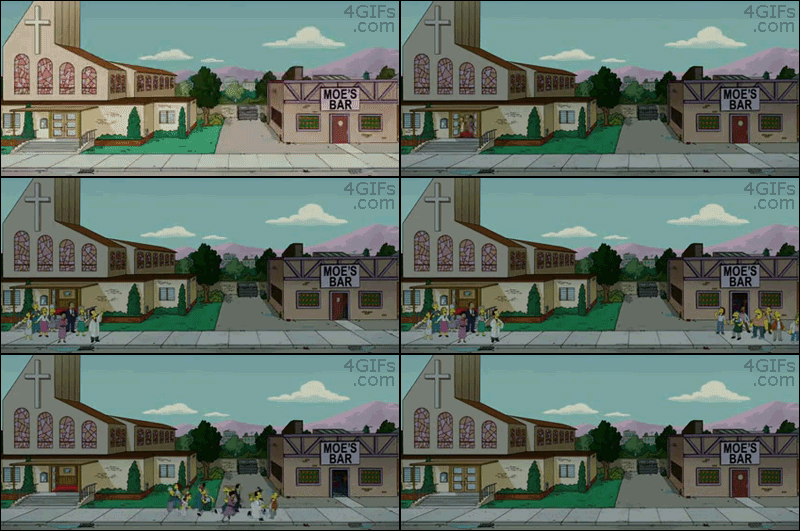
I sometimes can't help but think about the Simpsons when the topic of religion comes up.  It was always a favorite show of mine growing up despite my parent's protests. This clip below is just too funny not to share. Springfield had become so environmentally polluted that the government was bringing in a giant glass dome to quarantine off the city.  As this dome is being delivered from above by a fleet of helicopters, the worshippers in the church and the alcoholic bar patrons both run outside to see what's going on. After seeing the apocalyptic visual, the two groups hilariously swap places!  The bar patrons suddenly run to religion and the religionists suddenly run to the alcohol.   


Video in case the gif doesn't work. 


Anyway, it's been said that there is an ongoing competition, one that seeks to turning the gospel of Christ into religion. And then to turn the religion away from its founding.  We need to be on guard.  This has happened before and is happening again.  

The religion and faith in the Book of Mormon brought its authors into direct contact with Christ. Now what Joseph Smith said about the book starts to form an interesting and intriguing picture.  What if we consider the book as a manual.  An ascension text that will convince people of Christ by bringing them literally to Him. Not just bring them aboard a Church institution.  The book has examples, doctrine, prophecies and teachings that have escaped Babylonian influence. The first page has Lehi in direct contact with God.  These are not emotional and whimsical events, but literal, tangible experiences with God and angels right from page number 1. 

The wrong way to use a key is to use it to be prideful. God doesn't give us things to prop up our pride. Suppose the fullness of the Gospel is in the Book of Mormon (I believe it is), and people therefore feel great pride and superiority as a result of their religion's acceptance of the book?  Does that help them use the key?  Will using a key in that way ever open anything?  The Book of Mormon’s purpose can't be to solidify that ours is the only true Church and that as members our understanding is therefore superior to everyone else.  That key opens nothing.    

Have we been using the book incorrectly? 

Suppose for a minute 
we take our modern day Church and Gospel vocabulary, and all the ideas, definitions, Sunday school conversations and then overlay all of that on top of the Book of Mormon text.  This happens all the time.  It leads us to assume “this” thing that we do s part of our religious culture is the exact same as “that” thing you read about in the Book of Mormon. They use the same terms so they must be equal, right?  The Church leaders and manuals teach and encourage us to make these equivalencies.  One example: Book of Mormon Student Manual talking about Alma:

Book of Mormon prophets gave the title priest to officers known in this dispensation as high priests. That is, they were priests of the Melchizedek Priesthood, or as Alma expressed it, ‘the Lord God ordained priests, after his holy order, which was after the order of his Son.’ (Alma 13:1–20.)”      

This kind of teaching clouds our minds and tries to create equivalencies to pacify us rather than educate us.  Let's explore it and see how it pans out.  Let's take the idea of a high priest in our dispensation and see how it compares to "his holy order after the order of his Son". 

Our LDS mental picture of a high priest is something like a bishop or stake president or high counselor. A high priest occupies part of a hierarchy in the overall Church structure.  Our idea of a priest is one of the young men who passes the sacrament with a white shirt and tie (has to be a white shirt by the way, no colored shirts allowed!).  They are part of the organizational structure and are governed by higher ranking authorities, Church policies, and procedures. To become a priest is something largely automatic based on a young man's age.  Similarly, being ordained a high priest is a result of the Church office you occupy and often involves biological age, income, what callings you’ve had, your managerial skills.  Men lay hands on your head. Morally diverse people continue to be called and ordained to these positions in our day.   

Can we assume both the Book of Mormon and ourselves are referring to the same basic thing because we both use the word priest??  

Contrast Alma 13:1-12 for the scripture meaning of Prist, with handbook for the Church's meaning.  The activities surrounding them are quite a contrast.    

Here's an interesting side by side of what Priest/High Priest referred to in scripture, vs on the right column what the term means and the activities it involves religiously in our day: 


Unfortunately, today these Church titles of High Priest regrettably involve people who perpetrate abuse of the worst kind.  I remember a few years ago there was a few year timespan where the increase in sex scandals involving LDS high priests was shocking (link, link, link, link, link). 

That aside, we still need to decide the question: Could overlaying our latter-day mental pictures (such as "priest") onto the Book of Mormon create some misunderstanding and distort what the book is teaching?       

It seems wiser to begin with the premise that the book of Mormon is what should teach us.  The book should provide US the vocabulary and meaning of those words.  Creating equivalencies only clouds the issue and inflates our pride.  The Book of Mormon should be the standard we measure our day against even if it's terribly humbling and eye opening.  Inverting that relationship seems like something we should be on guard for.  Using a key like that will obviously never open the heavens for us.   

Returning to the main topic of this post, what is the purpose of The Book of Mormon.  

Consider that the purpose is perhaps NOT: 
-To validate the truth claims of one specific Church sect.
-To validate our modern beliefs that because we use the same religious vocabulary that we also share the same ideas, Priesthood, understanding, faith, and standing with God.       
-To serve as a tool to elevate ourselves above others with claims to exclusivity, superiority, or a monopoly on the fullness of the Gospel.        

Consider the Book of Mormon's purposse as perhaps:  
(to name a few)
-A covenant  
-A text intended to reconnect the individual with God.  An ascension text.   
-A standard to which we can compare teachings and ideas we encounter.
-To test the faith of the reader (RE 3 Nephi 12:1)
-Warning, prophecy, and knowledge of how to avoid destruction. 

One purpose of the Book of Mormon highly relevant to our day is to reveal that God made a covenant with Abraham in the beginning. And at the end God intends to vindicate that covenant that God made with Abraham by changing gentiles into the house of Israel by covenant.

Circling back to something Joseph Smith said: 

“I told the brethren that the Book of Mormon was the most correct of any book on earth, and the keystone of our religion, and a man would get nearer to God by abiding by its precepts, than by any other book.” (History of the Church, 4:461.)

What is a "precept" anyway?  And how does one "abide" a precept?  How can we follow Joseph's teaching here if I'm not sure what many familiar but older words even mean?   

Continued in Part 5.

Sunday, September 1, 2024

BofM Part 3: Neglected and Ignored

Continued from part 2. 

If there was someone in LDS history who did NOT neglect the Book of Mormon, it was Hugh Nibley.  Here are some of his thoughts:   

 “The first rule of historical criticism in dealing with the Book of Mormon or any other ancient text is, never oversimplify. For all its simple and straightforward narrative style, this history is packed as few others are with a staggering wealth of detail that completely escapes the casual reader. The whole Book of Mormon is a condensation, and a masterly one; it will take years simply to unravel the thousands of cunning inferences and implications that are wound around its most matter-of-fact statements. Only laziness and vanity lead the student to the early conviction that he has the final answers on what the Book of Mormon contains.”  — Hugh Nibley, 1952 (The Collected Works of Hugh Nibley, Vol. 5: Lehi in the Desert / The World of the Jaredites / There Were Jaredites [Deseret Book/FARMS, 1988] p. 237.)   

I love this: "Only laziness and vanity lead the student to the early conviction that he has the final answers on what the Book of Mormon contains." 

This blog series is one attempt to avoid any of that laziness and vanity.  

Hugh brings up vanity, which the scriptures also speak of when it comes to the neglect of the Book of Mormon by the audience to whom it was first given.

D&C 84:54-57

And your minds in times past have been darkened because of unbelief, and because you have treated lightly the things you have received—  Which vanity and unbelief have brought the whole church under condemnation. And this condemnation resteth upon the children of Zion, even all. And they shall remain under this condemnation until they repent and remember the new covenant, even the Book of Mormon and the former commandments which I have given them, not only to say, but to do according to that which I have written.

It says the book of Mormon is a new covenant.  Which ordinance in the LDS church is this covenant referring to?  Where does one accept this covenant?  How does one accept it?  The verse also speaks of unbelief, darkened minds, vanity, treating things lightly.  Did these things really happen? Are any of them still happening?  It says the condemnation will remain until the terms are met. 

How does scripture get actively published yet also neglected?  

In our own church history, for at least a hundred years, the Church itself hardly recognized the Book of Mormon. Some even advocated for the Church to abandon it in the 50's.  I'm not kidding, keep reading.  

Hugh Nibley was invited to speak to at various meeting at the University of Utah in the 1950's and participated in debates about the Book of Mormon. After giving one presentation Hugh says they took him aside and told him "You're among friends now, you can say what you really feel about the Book of Mormon".  Hugh defended the Book of Mormon, and that Joseph Smith was a prophet. "Oh, were they mad" Hugh said. "They were just boiling".  He recalls one member of the group launching into a harangue about the Book of Mormon saying: 
"We have to get rid of it. It's driving the best minds out of the Church! You can't see it, but with my training, I know it. Joseph Smith was a deceiver, but he was a sly deceiver."  
Hugh was chilled by such reactions. "They had a real active hatred of the Book of Mormon" he said.  These were for the most part members of the Church in good standing.  Among whom was O.C. Tanner and Sterling Mcmurrin who were upset or flabbergasted with Hugh's defense of the Book of Mormon.  (Peterson, Boyd Jay, Hugh Nibley:A Consecrated Life. Salt Lake City: Greg Kofford Books,2002, p.160.)
 
Hugh Nibley is one of the people most meriting mention when it comes to the LDS Church (or anyone else) beginning to care about and actually use of the Book of Mormon.  Hugh Nibley took it seriously even when the Church did not, and some intellectuals wanted to abandon it.   

Hugh also referred to the Book of Mormon once as “the Book Nobody Wants".  One of Nibley’s most well-known parables has application to the Book of Mormon.

A young man once long ago claimed he had found a large diamond in his field as he was ploughing. He put the stone on display to the public free of charge, and everyone took sides.

A psychologist showed, by citing some famous case studies, that the young man was suffering from a well-known form of delusion. An historian showed that other men have also claimed to have found diamonds in fields and been deceived. A geologist proved that there were no diamonds in the area but only quartz: the young man had been fooled by a quartz. When asked to inspect the stone itself, the geologist declined with a weary, tolerant smile and a kindly shake of the head. An English professor showed that the young man in describing his stone used the very same language that others had used in describing uncut diamonds: he was, therefore, simply speaking the common language of his time. A sociologist showed that only three out of 177 florists’ assistants in four major cities believed the stone was genuine. A clergyman wrote a book to show that it was not the young man but someone else who had found the stone.

Finally an indigent jeweler named Snite pointed out that since the stone was still available for examination the answer to the question of whether it was a diamond or not had absolutely nothing to do with who found it, or whether the finder was honest or sane, or who believed him, or whether he would know a diamond from a brick, or whether diamonds had ever been found in fields, or whether people had ever been fooled by quartz or glass, but was to be answered simply and solely by putting the stone to certain well-known tests for diamonds. Experts on diamonds were called in. Some of them declared it genuine. The others made nervous jokes about it and declared that they could not very well jeopardize their dignity and reputations by appearing to take the thing too seriously. To hide the bad impression thus made, someone came out with the theory that the stone was really a synthetic diamond, very skillfully made, but a fake just the same. The objection to this is that the production of a good synthetic diamond 120 years ago would have been an even more remarkable feat than the finding of a real one.

Book of Mormon classes at BYU weren’t even available until 1961. It’s hard to argue the Book of Mormon wasn’t neglected.   

In 1970 President Joseph Fielding Smith remarked:
“I could make a guess, and I do not think I would be too far out if I did say that one-half of the members of the Church have not read the Book of Mormon.” (Joseph Fielding Smith, Seek Ye Earnestly, 1970, p. 96.) 
Noel B. Reynolds notable BYU professor and former Director of FARMS wrote in 1999: 
 “The Book of Mormon was largely overlooked throughout the 19th and early 20th centuries. A handful of church leaders appealed for more serious attention to the book, however the church as a whole did not respond in any dramatic way to any of these urgent messages until after Pres. Benson's emphatic messages in 1986.” Within 18 months of the restoration through Joseph Smith, the Saints were condemned for unbelief. By January 1841 the Saints were warned they would be rejected with their dead if they failed to repent and keep God's commandments. They did not repent.” (The Coming Forth of the Book of Mormon in the 20th Century” found at BYU Studies, Volume 38.)

On page 127 of Hugh Nibley's Biography is a description of what happened in the Christian church during the history of Christianity and the early church fathers. Nibley is speaking here about a point in history a couple of hundred years after Christ, into the period when the apostles are gone, and there's a limit on ongoing revelation.  Hugh says: 

When the Church lost revelation it had to turn to another source for guidance and so it threw itself into the arms of the established schools of learning. The schoolmen, as one of them expresses it, took over the office and function once belonging to the prophets and once in power guarded their authority with jealous care, quickly and violently suppressing any suggestion of a recurrent inspiration.

Later on that same page: 

While I was at Berkeley I was asked to speak to a student group on the subject, “Is the University of California anti-religious?” After considerable inquiry, I was forced to admit that the Berkeley institution is if anything less anti-religious than BYU, where religion is under more conscious and deliberate attack. But I do not for that reason hold my BYU colleagues culpable—they cannot help themselves. By its very nature the university is the rival of the Church; its historic mission has been to supply the guiding light which passed away with a loss of revelation, and it can make no concessions to its absolute authority without forfeiting that authority
.

After that one sinks in, here's another quote worth noting: 

The celebrations of the learned men and not the utterances of the prophets comprise the gospel [according to the university]. This has been the credo of the Christian schoolmen since the days of Clement of Alexandria: the universities—Christian, Moslem, Jewish, or pagan—has its own religion, and the basic tenet of that religion is the denial of revelation.

If it's the nature of the University to rival the Church we ought to be on guard for this.  The Universities or "learned" can come to replace revelation.  When minds are darkened revelation is denied and replacements for revelation are then relied upon.  The shift from revelation to scholarship is something that can easily go unnoticed.  Hugh seems to be sounding the alarm bell that it has happened again, this time to us.  D&C 84 mentioned vanity, unbelief, darkened minds, and treating things lightly.  We've seen some possible application of that verse.  But have we also treated the Book of Mormon lightly as a church? The Lord called it a covenant in 1832.  So what exactly happened? 

Adoption and Sustaining

Looking at the Joseph Smith papers, we can read the minutes from all the early General Assemblies held by the church.  Canonization of new scripture is not very common, and there are records of when it has happened. One example is on page 307 of Volume 2 of the Revelations and Translations in the Joseph Smith Papers. Or here: Minutes, 17 August 1835, Page 106 (josephsmithpapers.org)


This was one those events in Church history when our scriptures were accepted by a common consent sustaining vote of the church body.  These minutes are available online and it's very easy for anyone to go see what got canonized, accepted and sustained.  Curiously absent from sustaining and canonization is the Book of Mormon.  The Lectures on Faith got accepted, The Doctrine & Covenants got accepted.  A First Presidency, a high council, D&C, including the Lectures on Faith. The Church does publish it, quote from it, and encourage the members to read it, but the Book of Mormon has never been formally accepted as a volume of scripture by the Church of Jesus Christ of Latter-day Saints.  This may be shocking to some, but it's true.  The widespread acceptance creates an assumption that history doesn't support.   


Formally accepting the book as scripture, and as a covenant (or lack thereof) may seem like an inconsequential formality.  However you view the lack of any sustaining vote, it's worth considering in light of the Lord's condemnation of the early stains for neglecting the book (D&C 84:54–57).  Condemnation which the Church leaders themselves have repeated and stated is still in effect upon the Church.

-1986- General Conference: Ezra Taft Benson:

We have made some wonderful strides in the past. We will be lengthening our stride in the future. To do so, we must first cleanse the inner vessel by awaking and arising, being morally clean, using the Book of Mormon in a manner so that God will lift the condemnation, and finally conquering pride by humbling ourselves. 

-Elder Oaks June 6 th 1993: “Along with other General Authorities, I have a clear recollection of the General Authority temple meeting on 5 March 1987. For a year, President Benson had been stressing the reading of the Book of Mormon. Repeatedly he had quoted these verses from the Doctrine and Covenants, including the Lord’s statement that the Saints’ conduct had “brought the whole church under condemnation” (D&C 84:55). In that temple meeting, President Benson reread those statements and declared, “This condemnation has not been lifted, nor will it be until
we repent.

Elder Oaks 2010:


A good reminder from Hugh Nibley, page 735 in Hugh Nibley Observed
Because Nibley believed that new discoveries in ancient digs and ancient texts bore witness that truths and records of historical events restored in our day were also known in former times, he saw them as a “reminder to the Saints that they are still expected to do their homework and may claim no special revelation or convenient handout as long as they ignore the vast treasure-house of materials that God has placed within their reach.” (Hugh Nibley Observed, p. 735, citing H. W. Nibley, New Look, May 1970, p. 91.)
What about in the last 10 years?      

Of the flurry of changes the LDS church has made in the past 10 years have any of them addressed the condemnation?  Looking at some of the biggest and most publicized changes covered in the news and at General Conference: 

-Using the full name of the Church as opposed to a nickname (post on that here).  President Nelson in his Conference talk Oct 2018 said:
...if we allow nicknames to be used and adopt or even sponsor those nicknames ourselves, he is offended.
That was fairly big news when it happened.  But I think we all have to agree it's not what the Lord said would remove the condemnation. Of note here, that teaching also contradicts the scriptures which specifically tell us "And in nothing doth man offend God, or against none is his wrath kindled, save those who confess not his hand in all things, and obey not his commandments".   The verse, seemingly predicting the future, went to the trouble of specifically clarifying what offends God.  And it did not include nicknames. 

-President Nelson promised the saints untold blessings if they would stop using the term Mormon. If we look at President Nelson's conference talk where he teaches this, and to stop using the term Mormon, notice the footnote he references for the promise.  It's referencing Joseph Smith in Liberty Jail, who in that very same letter, says and I quote "Truth is Mormonism".   More on that here.   

-2 hour church rather than 3. This change does have a positive outcome of reducing the amount of time people are bored at Church. Which for pretty much anyone I've ever spoken with has been cause for celebration. However, this too is not addressing the scripturally stated issues we face for which the condemnation was imposed. 

-Home Teaching getting renamed to Ministering isn't even acknowledging the condemnation the Lord said we are under.  So far we're 0 for 3.

-Policy changes regarding baptism, baptismal witnesses, temple ordinance changes, policies about kids of same sex parents etc. etc. These too are distractions.  None of them address what the Lord said to do in order to remove the condemnation. These are organizational policy and managerial changes that have largely stepped over what the scriptures say.  On what grounds can we claim blessings for doing things the Lord has never said to do, while at the same time NOT doing things the scriptures explicitly said to do? 

-New Church Logo?  Revised and now digital handbook?  New more global church magazine?  Being good global citizens?  Getting vaccinated? None of these address the issue. 

-Renovating Temples? Building new temples?  Temples in Rome that are hardly open? 

-The Bicentennial Proclamation of 2020. This proclamation mentions the Book of Mormon, and repeats basic church teachings, but does not address the condemnation nor accomplish much in terms of getting out from under it.

-Discontinuing Priesthood and Women's session of General Conference.  Prior to October of 2014 the Women's meeting wasn't officially one of the "sessions" of General Conference.  They added it in 2014 as an official session.  This was reported to be great and welcomed news in the newspaper articles.  However now in 2021, it was apparently deemed so useless that it's been discontinued all together.  Then again in 2021 was another reversal, this time reinstating a Sat evening session for all audiences.   

All these changes can all lull us into a feeling of security that all is well, and that the quantity of changes must mean that God is hastening his work.  And yet the changes across the board do not address the condemnation.  So, what would address it?  

Repentance

Of note here is in 2017 an independent group of truth-seeking individuals brought about the Restoration Edition of the Scriptures. This project had as its goal to restore a set of scriptures to as true a version as possible to what Joseph Smith gave us. They utilized all extant documents, and all of Joseph's edits, verbal or written and attempted to restore the Book of Mormon as an act of repentance and sign to God that we seek the source. Some of what was identified and included has never been included in print until this Restoration Edition of the Scripture. To recap a little of that effort, it restored the Book of Mormon, the Joseph Smith Translation of the Bible, it restored the Lectures on Faith to their proper place in scripture, and put the revelations of Joseph Smith back to a purer state before and without edits, changes, expansions by men which all occurred.  The Lord himself also spoke and added content. 

It was a small independent group of volunteers acting in faith. Not affiliated with any church. And yet, the small group sought to repent and remember. It's known as the Restoration Edition of the Scriptures. It's different from LDS version in some interesting ways. The new edition of the scriptures is the first time the full work Joseph accomplished, without additions and including hundreds of punctuation changes previously omitted, have been made available in print. 

Regarding the Book of Mormon specifically, since the Restoration began, the people from the first publication in 1830 until September of 2017 in Boise Idaho, no one accepted the Book of Mormon as a covenant. Various other things got accepted but not the Book of Mormon as a covenant, until September 2017.  So, it is possible to come out from under the condemnation and accept the book as a covenant. 

To get the benefit of the Book of Mormon and the covenant it was intended to be, we need to remember it and do what it says. Then develop faith, and use it to correct our thoughts, actions and beliefs. But the Book of Mormon has often devolved into a marketing tool to convert people to a specific religious institution. It seems the book's purpose has long been on a detour.

Continued in part 4. Distracting Detours